
How To Study For BSC With Google Gemini AI

Boosting BSC Preparation With AI. Your Own Personal Tutor, Google Gemini.
Starting a Bachelor of Science (BSc) degree is your launchpad to a high-value career in Research, Medicine, Technology, and Analytical fields, offering specialized roles globally. To achieve this, you must successfully master complex academic areas like Chemical Reactions, Biological Processes, and Advanced Mathematics/Physics to maintain competitive grades. Grasping these complex scientific ideas can feel overwhelming, but the fact that you are actively seeking advanced tools proves your commitment—scientific mastery is guaranteed with the right strategy. You need a smart assistant always ready: Artificial Intelligence (AI) is your secret weapon for conquering your BSc course. AI can instantly explain tough scientific ideas, guide you through complex equations, help visualize molecular structures, and brainstorm experiment designs in real-time. My journey has shown me AI’s incredible power; I’ve personally used it to level up my skills in data analysis and digital marketing, and I even used these tools to build this website. This guide shows you exactly how to transform AI into a powerful, personalized learning tool for your BSc subjects. Get ready to stop studying harder and start exploring your new world of science smarter.
How Gemini Helps With Every BSC Subject
| Focus Area | What Gemini Does | Your Benefit |
|---|---|---|
|
|
Physics Concept Guide
|
It makes hard math much easier to learn. By following simple steps, you will understand how to use formulas correctly in your exams. |
|
|
Chemistry Logic Tutor
|
You stop just memorizing long lists. You learn the real logic of chemistry, making your lab work and tests much smoother. |
|
|
Life Systems Expert
|
It helps you see the "big picture" of life. This makes it much easier to write great answers for long essay questions in your exams. |
|
|
Math Logic Checker
|
It ensures your work is always right. By checking your logic, you gain the confidence needed to pass high-stakes math papers. |
|
|
Code Logic Assistant
|
It makes your lab work much faster. You learn to write clean code, which is a key skill for your future career in technology. |
|
|
Scientific Report Builder
|
It makes your work look very professional. By following high academic rules, you ensure your research projects get the best marks. |
How AI Boosts Your Efforts : Data From Recent Studies
For a Bachelor of Science (BSc) student, the transition from high school to university-level science can be a “cognitive shock.” You are moving from memorizing laws to proving them, and from observing nature to simulating it. Modern cognitive science and 2025 educational reports prove that AI is no longer just a “tool”—it is a catalyst for the scientific method itself.
Here is the scientific breakdown of how AI transforms your academic performance, your scientific inquiry, and your future career.
| Research Metric | Evidence & Analysis | Academic Significance |
|---|---|---|
| 20–35% higher academic scores Active Learning Meta-analyses |
Active Learning Improves Science Exam Performance
|
What This Means
AI-supported active learning strengthens conceptual understanding, not just rote memorisation — critical for BSc science subjects.
BSc Edge: Higher marks in theory-heavy and numerical-based papers.
|
| 25–40% error reduction AI Practice & Diagnostics Research |
Diagnostic Learning Reduces Repeated Mistakes
|
What This Means
AI identifies exactly where your scientific reasoning breaks, preventing the same mistakes from repeating across exams.
BSc Edge: Fewer numerical and derivation errors in Physics & Chemistry.
|
| 30–40% stronger retention Spaced-Revision Studies |
Spaced Revision Preserves Core Scientific Concepts
|
What This Means
AI ensures that formulas, mechanisms, and definitions stay active in memory throughout the academic year.
BSc Edge: Retains formulas, reactions, and biological pathways.
|
| 20–30% application accuracy AI Metacognition Research |
Metacognitive Feedback Improves Problem Application
|
What This Means
AI shows when a topic feels familiar but isn’t exam-ready — a major cause of score loss in science exams.
BSc Edge: Stronger performance in application-based questions and numericals.
|
Advanced Prompting Techniques by Google for 2026, with Examples Prompts For BSC
Google Gemini is a Reasoning Engine. To get "A+ Grade" results for BSc and pure science students, move beyond basic questions using these six pillars.
- The Technique: Setting the Persona, Task, Context, and Format.
- The Logic: AI is a reasoning engine that adapts to the "identity" and "environment" you provide. Assigning an expert role ensures professional scientific vocabulary, while the Context "fences" the AI into a specific syllabus or source (like NCERT or a specific University Lab Manual) to prevent it from giving irrelevant, non-academic data.
Persona: Act as an [Any Expert Role: e.g., Senior Research Scientist, Physics Professor, Lab Supervisor]. Task: Explain [Your Topic: e.g., Quantum Entanglement, Organic Mechanisms, Cell Signaling]. Context: Apply this specific background: [Source Context: e.g., Use only the standard BSc Chemistry University Syllabus] [Difficulty Context: e.g., Explain for a 2nd-year BSc student] [Lab Context: e.g., Assume the context of a standard wet-lab environment] Format: Provide the answer as a [Structure: e.g., Technical Summary, 5-Point High-Yield List].
- The Technique: Breaking a problem into a "Step-by-Step" sequence with logic checks.
- The Logic: Pure Science problems in BSc often fail because the AI jumps to conclusions. This version forces the AI to "Self-Correct"—cross-checking the logic of Step 1 (identifying variables) before it attempts Step 2 (the calculation or derivation).
Solve this [Subject: e.g., Calculus-based Physics, Physical Chemistry] problem using Chain-of-Thought. Step 1: List all given [Variables/Constants] and units from the question. Step 2: State the core [Formula/Theory] and verify its relevance to the question. Step 3: Show the calculation step-by-step, verifying the logic of each line before moving to the next. Question: [Insert your numerical question here]
- The Technique: Limiting the AI to official domains with a focus on recent data.
- The Logic: Scientific research and university patterns change frequently. This "Time-Stamp" filter forces the AI to ignore third-party coaching blogs and prioritize official portals (like NPTEL, NASA, or University sites) from the last 12 months for 100% accuracy.
Research the [Topic: e.g., Latest CSIR-NET Syllabus changes, New research on CRISPR]. Constraint: Only use info from official portals: [Domain 1: e.g., nptel.ac.in] and [Domain 2: e.g., nature.com]. Recency Rule: Prioritize data published in the last 12 months. Output: Provide the official summary and the direct link to the source.
- The Technique: Setting strict "Rules of Play" including forbidden keywords.
- The Logic: Scientific notes should be sharp and objective. By setting hard boundaries and forbidding "AI-voice" fillers (like "Essentially" or "I hope this helps"), you get professional high-yield notes for rapid revision.
Explain [Concept: e.g., Photoelectric Effect, SN2 Reaction]. Constraint 1: Use only [Specific Source: e.g., NCERT, Standard Academic Text] terminology. Constraint 2: Keep the response under [Limit: e.g., 100 words]. Constraint 3 (Negative): Do not use AI-filler phrases like "Basically" or "In conclusion." Format: Use simple bullet points.
- The Technique: Using a Feedback Loop with an "Active Recall" check.
- The Logic: Treat the AI like a thesis advisor. This version forces the AI to stop and ask you a question after its explanation, ensuring you actually understood the concept (like the Heisenberg Uncertainty Principle) before moving on.
Explain [Topic: e.g., Maxwell’s Equations, Protein Folding]. Instruction: Provide a high-level technical summary first. Feedback Loop: Ask me if I want it simpler for basics or more technical for the exam. Active Recall: Once I am satisfied, provide one 'Check-for-Understanding' question based on your explanation.
- The Technique: Providing a structural blueprint before injecting raw data.
- The Logic: This is the most powerful way to stop AI from guessing. You command the AI to build a specific result (like a taxonomic classification table) using a layout you provide, ensuring it is 100% ready for your lab file or project.
Make a [Desired Output: e.g., High-Yield Comparison Table, Lab Observation Checklist]. Layout Blueprint: [Structure: e.g., 3-column table, Markdown list]. Style: [Vibe: e.g., Academic Minimalist, Professional]. Strict Rule: Adhere to the structure provided; no conversational filler. Use this information: [PASTE_DATA_OR_TEXT_HERE]
Note :
- “The techniques and prompt engineering principles you learn in this guide are universally applicable to any large language model (LLM), including ChatGPT and Perplexity AI. We use Google Gemini for all examples because its latest multimodal features and integration with Google Search provide a best-in-class learning experience.”
- “Remember: The quality of the AI’s answer depends entirely on the clarity of your prompt. Always be specific, detailed, and clear with the AI to avoid irrelevant or incorrect (hallucinated) responses.”
Using Google Gemini App Input Method’s For Bsc.
1. Text Prompts

This will be your primary and most powerful tool for posing highly specific, conceptually challenging questions across all your BSc subjects. You can seek detailed explanations of scientific principles, request step-by-step derivations of formulas or proofs, and even ask for comparative analyses of different theories or models.
2. Voice Input
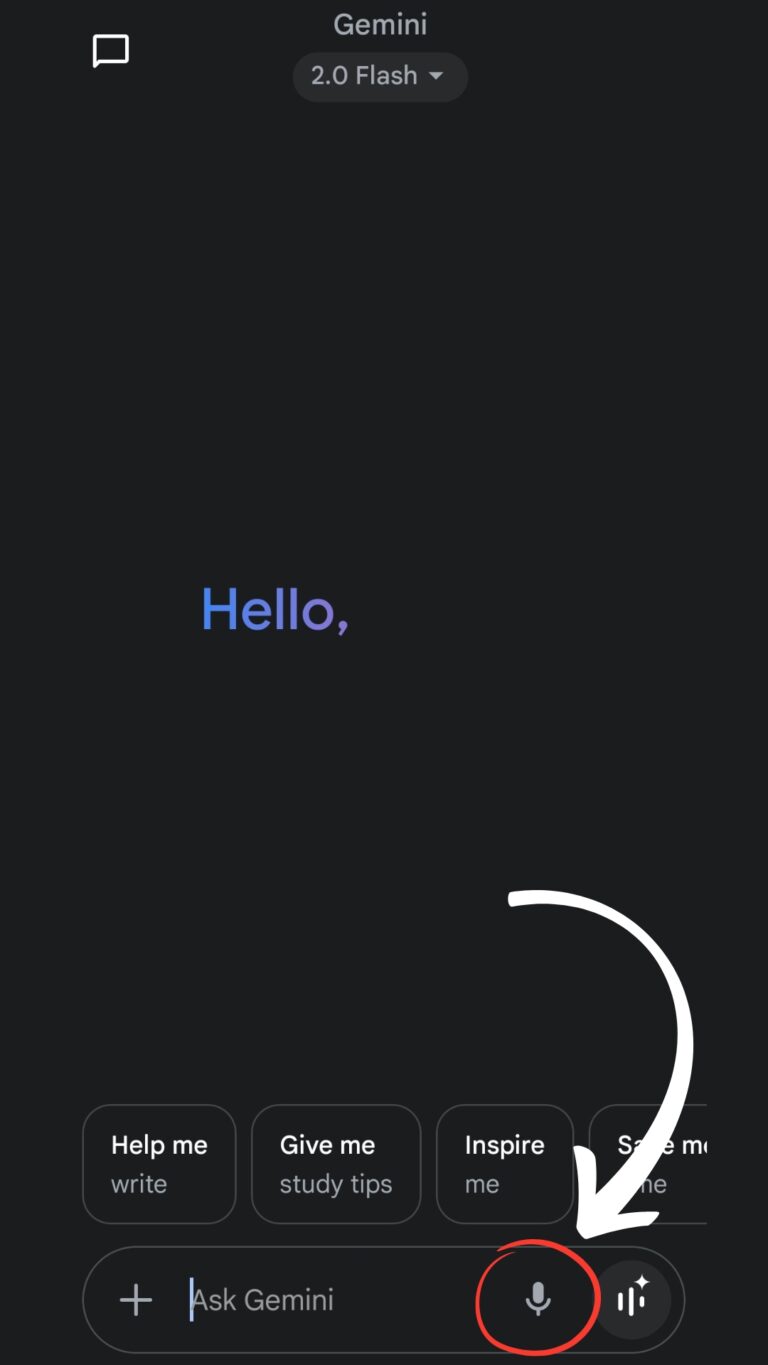
For quick conceptual clarifications during intense study sessions, brainstorming experimental procedures, or even rapidly reviewing key scientific terms, mathematical definitions, and physical constants on the go, utilize voice commands to interact with Gemini. This offers an incredibly convenient avenue for instant academic assistance, ensuring no crucial detail or challenging concept remains unresolved during your BSc journey.
3. Image Input

When faced with a complex chemical structure, a detailed biological diagram, an intricate mathematical graph, a physics circuit diagram, or a geological map from your BSc material, simply capture a clear image and upload it to Gemini. You can then ask targeted questions about the identification of components, the interpretation of processes, the understanding of relationships depicted graphically, the analysis of systems, or request explanations of geological formations
Questions From The BSc Course Syllabus Solved Using Google Gemini.
Example 1: BSc Chemistry
Nucleophilic Substitution ($S_N1$ vs. $S_N2$ Mechanisms)
Official Path: Organic Chemistry: Reaction Mechanisms
Kinetics of Nucleophilic Substitution and Stereochemistry of $S_N1$ and $S_N2$
Research "Kinetics of Nucleophilic Substitution" and "Stereochemistry of $S_N1$ and $S_N2$." In B.Sc. Chemistry, the ability to predict whether a reaction will proceed via a unimolecular or bimolecular pathway is fundamental. Grounding the prompt in "Transition State Theory" and "Carbocation Stability" ensures the AI explains why tertiary halides prefer $S_N1$ while primary halides prefer $S_N2$, providing the mechanistic rigor required for university examinations and laboratory synthesis.
Study Lab
B.Sc. Chemistry Prep
"An alkyl halide, 2-bromo-2-methylpropane, is reacted with a weak nucleophile like water. In another experiment, bromomethane is reacted with a strong nucleophile like hydroxide ion ($OH^-$). Explain the differences between the $S_N1$ and $S_N2$ reaction mechanisms. Identify which reaction follows which path and discuss the impact of solvent polarity and steric hindrance on the reaction rates."
"Act as a Research Chemist and Organic Chemistry Professor (Persona). Explain the concepts of $S_N1$ and $S_N2$ Reaction Mechanisms (Subject) using primary and tertiary alkyl halides (Context). Focus on the 'Rate-Determining Step' and the role of the nucleophile. Provide a comparative conceptual breakdown (Format) of how the molecularity of these reactions differs."
"Analyze the Stereochemical and Environmental Factors of these reactions using Chain-of-Thought. Step 1: Describe the stereochemical outcome of an $S_N2$ reaction (Walden Inversion). Step 2: Explain the outcome of an $S_N1$ reaction (Racemization). Step 3: Evaluate the effect of a 'Protic' vs. 'Aprotic' solvent on the $S_N2$ rate. Step 4: Verify the stability of the intermediate in the $S_N1$ reaction and how it dictates the final product."
"Create an Organic Reaction Prediction and Troubleshooting Map for chemistry students. Structure: Substrate Type, Favored Mechanism, The 'Key Constraint', Lab Observation. Constraints: Use a structured hierarchical list. No conversational filler. Ensure 100% accuracy for B.Sc. Chemistry standards."
B.Sc. Chemistry Study Lab • Optimized for Mechanisms
Gemini can further assist by:
- Illustrating the energy profile diagram for the SN1 reaction.
- Comparing and contrasting the SN1 and SN2 reaction mechanisms.
- Predicting the products of SN1 reactions given different substrates and nucleophiles relevant to your BSc syllabus.
Example 2: BSc Biology
Mechanism of DNA Replication in Prokaryotes
Official Path: Molecular Biology: DNA Replication
Replication Fork Enzymes and Directionality of DNA Synthesis
Research "Replication Fork Enzymes" and "Directionality of DNA Synthesis." In B.Sc. Biology, understanding the antiparallel nature of DNA and the limitations of DNA Polymerase (which only synthesizes in the $5'$ to $3'$ direction) is the key to mastering molecular genetics. Grounding the prompt in the "Continuous vs. Discontinuous Synthesis" ensures the AI explains the mechanical necessity of fragments, providing the biological rigor required for university examinations and biotechnology research.
Study Lab
B.Sc. Biology Prep
"During the process of semi-conservative DNA replication in E. coli, several enzymes work in a coordinated manner at the replication fork. Explain the specific roles of Helicase, Primase, and DNA Polymerase III. Discuss the difference between the Leading Strand and Lagging Strand synthesis and explain why 'Okazaki Fragments' are formed only on one of the strands."
"Act as a Molecular Biologist and Genetics Professor (Persona). Explain the Enzymatic Machinery of DNA Replication (Subject) in a prokaryotic system (Context). Focus on the initiation at the 'Origin of Replication' and the unwinding of the double helix. Provide a functional summary (Format) of how the replication fork is stabilized."
"Analyze the Mechanism of Leading and Lagging Strand Synthesis using Chain-of-Thought. Step 1: Describe the $5'$ to $3'$ synthesis direction of DNA Polymerase III. Step 2: Explain how the 'Leading Strand' is synthesized continuously toward the replication fork. Step 3: Explain why the 'Lagging Strand' must be synthesized in short bursts away from the fork. Step 4: Verify the role of DNA Polymerase I and Ligase in finalizing the lagging strand."
"Create a DNA Replication Error and Repair Guide for biology students. Structure: Replication Error, Cellular Consequence, The Enzymatic 'Repair Kit', Biological Significance. Constraints: Use a structured hierarchical list. No conversational filler. Ensure 100% accuracy for B.Sc. Biology standards."
B.Sc. Biology Study Lab • Optimized for Genetics
Gemini can further assist by:
- Explaining other Mendelian laws (Law of Segregation, Law of Dominance).
- Solving complex genetics problems involving multiple genes and different inheritance patterns (e.g., incomplete dominance, codominance, sex-linked inheritance).
- Illustrating the process of meiosis and how it relates to the segregation and independent assortment of alleles relevant to your BSc syllabus.
Example 3: BSc Physics
The Second Law and Carnot Cycle
Official Path: Thermodynamics and Statistical Physics: Laws of Thermodynamics
Reversibility and Entropy in Heat Engines and Carnot’s Theorem
Research "Reversibility and Entropy in Heat Engines" and "Carnot’s Theorem." In B.Sc. Physics, the distinction between an ideal (Carnot) cycle and real-world dissipative processes is a cornerstone of classical physics. Grounding the prompt in "Isothermal and Adiabatic Transitions" ensures the AI explains the energy flow within the cycle, providing the mathematical and conceptual rigor required for university examinations and thermal engineering.
Study Lab
B.Sc. Physics Prep
"A heat engine operates between a high-temperature reservoir at 600 K and a low-temperature reservoir at 300 K. Calculate the Maximum Theoretical Efficiency of this engine. If the engine absorbs 1000 J of heat from the source, determine the work done and the heat rejected. Explain why no real engine can achieve 100% efficiency based on the Second Law of Thermodynamics."
"Act as a Theoretical Physicist and Thermodynamics Professor (Persona). Explain the concept of the Carnot Cycle (Subject) operating between two thermal reservoirs (Context). Focus on the four stages of the cycle (Isothermal Expansion, Adiabatic Expansion, Isothermal Compression, Adiabatic Compression). Provide a technical summary (Format) of why efficiency depends only on the temperatures of the reservoirs."
"Analyze the Numerical Performance of the Carnot Engine using Chain-of-Thought. Step 1: Calculate the efficiency ($\eta$) using the Kelvin temperature scale. Step 2: Calculate the Work Done ($W$) based on the heat absorbed ($Q_1$). Step 3: Use the First Law of Thermodynamics ($Q_1 = W + Q_2$) to find the heat rejected ($Q_2$). Step 4: Verify the result by explaining the 'Kelvin-Planck Statement' of the Second Law."
"Create a Thermodynamic System Stability and Efficiency Map for physics students. Structure: Process Type, Entropy Change ($dS$), Efficiency Impact, Physics 'Red Flag'. Constraints: Use a structured hierarchical list. No conversational filler. Ensure 100% accuracy for B.Sc. Physics standards."
B.Sc. Physics Study Lab • Optimized for Thermodynamics
Gemini can further assist by:
- Providing animations or simulations of wave interference.
- Explaining the concepts of coherence and incoherence in wave sources.
- Solving numerical problems related to path difference, phase difference, and wavelength in interference experiments relevant to your BSc syllabus.
Using Google Gemini For BSc Research
What is Deep Research?
Deep research for B.Sc. (Bachelor of Science) involves using Google Gemini to connect core scientific theories with real-world laboratory data, experimental findings, and the latest peer-reviewed research. It turns the AI into a research assistant that helps you understand the "Why" behind scientific phenomena and mathematical proofs, moving beyond textbook definitions to the analytical mindset required for lab reports and advanced science exams.
How It Helps You
- Experimental Data Analysis: B.Sc. exams often involve interpreting experimental results. Gemini helps you find the link between your raw lab data and the underlying laws of Physics, Chemistry, or Biology.
- Simplifying Complex Proofs: Deep research allows you to break down difficult mathematical derivations or chemical reaction mechanisms step-by-step, making them easier to replicate in exams.
- Accessing Peer-Reviewed Context: Stay updated on the latest breakthroughs in journals like Nature or Science—topics that provide critical context for higher-tier marks in your research-based assignments.
- Hypothesis Building: Instead of just learning facts, Gemini can research the history of scientific discoveries to help you understand how hypotheses are formed and tested in real laboratories.
Grounding and Context
What it is: "Grounding" means tethering Gemini to official scientific databases and academic journals so it doesn't give you general misinformation or outdated scientific theories.
Why it matters: Scientific facts are precise and evidence-based. Grounding ensures you are studying from sources like PubMed, ArXiv, and Official University Lab Manuals.
How you do it:
1. Download the latest official University syllabus or Science Department course outline PDF.
2. Upload the PDF to Gemini.
3. Use the command: "Filter all your future research through the specific scientific laws and experimental requirements found in this official B.Sc. syllabus."
System-Task-Range Prompting
The Google Suggested MethodUse this structured method to ensure Gemini acts like a Senior Research Scientist or a Science Professor rather than a general chatbot.
“Act as a Research Scientist. Your task is to research the latest findings in [Specific Topic, e.g., Quantum Mechanics or Molecular Biology] published in 2025. Write a 200-word summary of how these findings relate to the 'Modern Physics/Cell Biology' chapter in my B.Sc. syllabus. Use only official peer-reviewed journals and verified scientific databases.”
Reverse Engineering Prompts
The India Should Know TechniqueReverse-engineer your study notes by describing the exact scientific depth and tabular format you need before the AI processes raw experimental data.
“I want to create a high-density comparison table for [Scientific Concepts, e.g., Mitosis vs Meiosis or Endothermic vs Exothermic Reactions]. Format: A 4-column table (Feature, Process A, Process B, Why This Matters in a Lab). Tone: Scientific, direct, and analytical. Intent: To master core conceptual differences for a 10-mark long-answer question. Constraints: No fluff. Every point must be under 15 words. Use the official textbook context I provided. Once generated, I will ask you to create a logic-based hypothesis question for this table.”
Tips for Better Deep Research
- The "Logic Loop": After an answer, ask: "What is the most common experimental error that leads to incorrect results in this scenario?" to identify common lab traps.
- Verify Scientific Data: Always use the "Google" search button to verify the latest atomic weights, physical constants, or biological classifications mentioned in your research.
- Visual to Text: If you are studying complex molecular structures or circuit diagrams, describe the connections to Gemini and ask it to explain the "unseen" force or chemical bond interaction.
- Chain of Reasoning: For mathematical derivations in science, tell Gemini: "Explain the transition from step A to step B step-by-step so I can apply this during a practical exam."
Guided Learning For BSc, Turn Google Gemini into Your Personal Coach
What is Guided Learning with AI?
For B.Sc. students, guided learning with AI is like having a PhD-level scientist or a laboratory supervisor available 24/7 to help you crack the logic behind scientific theories, experimental observations, and mathematical proofs. Instead of just searching for a summary or a final solution, you use Gemini to simulate a high-level research dialogue. It identifies gaps in your theoretical foundation and explains complex scientific concepts in ways that match your specific learning style.
How it helps you for this course/exam
- Master Theoretical Logic: Struggling with 'Quantum Mechanics' or 'Organic Mechanisms'? Gemini can break down the transition between observational data and theoretical conclusions, ensuring you understand the scientific behavior rather than just memorizing a law.
- Analytical Troubleshooting: Whether it is a calculation error in a physics derivation or a flaw in a chemical reaction path, Gemini can help you identify the logical gap in your approach, teaching you how to troubleshoot scientific problems like a professional researcher.
- Real-World Application Mastery: It can act as a technical science mentor, helping you visualize how academic subjects like Thermodynamics or Genetics are applied in modern-day research projects and industrial labs through practical examples.
How to do it in short
1. Define the Role: Tell Gemini it is an expert B.Sc. Professor specializing in subjects like Physics, Chemistry, Biology, or Mathematics.
2. Set the Boundary: Tell it NOT to solve the problem for you—insist on guiding you through the scientific methodology first.
3. Interactive Dialogue: Ask it to quiz you on a specific scientific principle or a theorem one question at a time.
4. Feedback Loop: Provide your logic for a derivation or an experiment, and let the AI correct your technical reasoning.
Google Suggested Method: Conversational Scaffolding
Google’s recommended approach focuses on "conversational scaffolding." For B.Sc., this means starting with basic scientific definitions or laws and letting the AI guide you toward solving full-scale analytical problems through a back-and-forth chat.
“I am studying for my B.Sc. exams, specifically focusing on [Subject/Chapter]. I want you to act as a supportive professor. Start by asking me what I already know about [Specific Topic], and then help me build my understanding by asking follow-up questions that connect basic logic to advanced scientific problems. Don't give me all the information at once; let's take it step-by-step.”
Google Suggested Method: The Socratic Method
The Socratic method is the gold standard for mastering scientific logic. Instead of the AI explaining a derivation or a biological cycle to you, it asks you a series of disciplined questions. This forces you to think through the logical and technical flow yourself, which is critical for long-term retention in pure sciences.
“I want to learn the core logic behind [Topic]. Act as a Socratic tutor for B.Sc. prep. Do not give me the explanation. Instead, ask me a leading question that helps me realize the core scientific principle behind this. Once I answer, ask another question to push my thinking into real-world application until I have fully grasped the concept.”
The India Should Know Method
The "Reverse Engineering" MethodThe India Should Know method is about Reverse Engineering. Instead of letting the AI wander, you put heavy constraints on the output. You define the exact "shape" of the session—specifying the need for high-density scientific formats—before you ever give it the raw experimental data or semester syllabus.
“Intent: Act as an expert B.Sc. Professor specializing in [Subject]. Context: I am preparing for my end-semester exams and need to master [Chapter/Topic]. Format Constraints: * Conduct a 'Step-by-Step Scientific Logic' or 'Experimental Breakdown' session. * Ask exactly one question or logic-part at a time. * Wait for my response before moving to the next part of the logic. * If I am wrong, provide a scientific hint rather than the final solution. * Use a professional and encouraging tone. * After 5 questions, provide a 'Conceptual Gap Report' in a table format (Column 1: Science Concept, Column 2: Mastery Level 1-10, Column 3: High-Yield Improvement Area). Raw Data: [Paste your notes, lab data, or syllabus here] Instruction: Once you understand these constraints and the data provided, acknowledge this by asking the first question.”
Tips for Guided Learning
- Be Honest with the AI: If you don't understand a scientific hint, say "I don't understand the logic behind this reaction/proof, explain it using a real-world analogy." The AI can pivot its teaching style immediately.
- Use Voice Mode for Viva Prep: If you are on the Gemini app, use Gemini Live. Talking through the logic of your experimental project or a complex cycle out loud helps build the clarity needed for viva sessions and written exams.
- Feed it Lab Data: Paste specific observations from your laboratory sessions into the "Raw Data" section. This ensures the AI quizzes you on the exact level of analytical rigor expected in your B.Sc. degree.
- Review the Gap Report: Don't just finish the session. Look at the "Conceptual Gap Report" and ask Gemini to create a 10-minute focus summary sheet just for the areas where you need more scientific clarity.
Note: Once Gemini produces the outcome based on these prompts, you can further improve it by saying: "That was great, but make the questions more focused on [Specific Sub-topic] and use more practical, research-style examples."
Important Links for BSc
A Bachelor of Science (BSc) requires more than just textbooks; it requires access to verified data, peer-reviewed research, and specialized tools. This vault contains the high-utility resources you need to transition from a student to a researcher in 2025–2026.
1. Research & Literature (The Scientist's Library)
BSc students must move beyond Wikipedia to credible, high-impact sources for their assignments and final-year projects.
Google Scholar: The gold standard for finding peer-reviewed papers, theses, and citations. Use the “Cited by” feature to find the most influential work in any field.
PubMed Central (PMC): An essential open-access database for Life Sciences and Biotechnology students, offering over 7 million full-text records.
arXiv.org: The go-to repository for Physics, Mathematics, and Computer Science students to access “pre-prints” (cutting-edge research before it hits traditional journals).
Science.gov: A massive gateway searching over 60 databases and 2,200 scientific websites, perfect for cross-disciplinary STEM research.
2. Virtual Labs & Simulation (The Bench-Work Bridge)
Don’t let limited lab hours hold you back. Use these to master techniques before you ever touch a piece of equipment.
LabXchange (Harvard): A free platform offering high-quality simulations for Gel Electrophoresis, Titration, and Microscopy. It’s like having a 24/7 lab on your laptop.
PhET Interactive Simulations (CU Boulder): Incredible visual simulations for Physics, Chemistry, and Earth Science that make abstract concepts (like circuit flow or atomic structure) “touchable.”
Wolfram Alpha: Not just a calculator, but a “computational knowledge engine.” Use it for complex Calculus, Chemical Balancing, and statistical data analysis.
3. Fellowships & Internships (2026 Opportunities)
A BSc is most valuable when paired with research experience. These portals are the main gateways for students in India.
Science Academies’ Summer Fellowship (SRFP 2026): The most prestigious program in India (IAS-INSA-NASI). It allows BSc students to work with top scientists for 2 months with a stipend.
ISRO/IIRS Internship Portal: Perfect for Physics, Geography, and Tech students looking to work on satellite data and remote sensing projects.
Skill India Digital Hub: A government aggregator for various paid and free internships across the scientific and technical sectors.
4. Upskilling & Certifications (The Career Multiplier)
Swayam (NPTEL): Free online courses from IITs and IISc. You can audit for free or pay a small fee to get an MHRD-verified certificate that looks great on an MSc application.
Coursera (Free-to-Audit): Look for “Data Science with Python” or “Bioinformatics” courses from universities like Stanford or Johns Hopkins to add a technical edge to your BSc.
LabPlot: A powerful, free, open-source tool for scientific plotting and data analysis. Mastering this will make your lab reports look professional and ready for publication.
Pro-Tip for BSc Success:
The “Black Book” Repository: Use OATD (Open Access Theses and Dissertations) to see how international students structure their final-year projects. It’s the best way to find “Gold Standard” examples for your own work.
Scientific Networking: Join ResearchGate. Many scientists upload their full papers for free here, and you can follow the researchers whose work you’re studying in class.
Your Path To BSc Success with AI Guidance
Google Gemini, with its comprehensive ability to process information across text and images, coupled with its vast knowledge base spanning the diverse disciplines of science, offers an unparalleled advantage in your demanding BSc course. By acting as an intelligent and readily available tutor, capable of clarifying intricate scientific concepts, guiding you through complex derivations, helping you visualize abstract structures and phenomena, and even brainstorming experimental designs on demand, it empowers you to engage with the rigorous curriculum on a deeper and more effective level.
Seamlessly integrating Gemini with your BSc study material creates a dynamic and highly supportive learning ecosystem, enabling you to tackle challenging topics, understand fundamental scientific principles, and ultimately approach your exams and future scientific endeavors with enhanced confidence and a more profound understanding of the natural world. Embrace this powerful AI tool as your dedicated ally, and unlock your full potential to excel in your BSc journey and build a solid foundation for your future in the realm of science.
The future of personalized, insightful, and visually-enhanced scientific learning is here, empowering you to illuminate your path to scientific mastery with AI brilliance.
Written By
Prateek Singh.
Last Updated – December, 2025
About The Author
Prateek Singh believes the best way to learn is to apply knowledge directly. He leverages AI tools every day for his professional work, using them to create sales presentations, perform lead generation, execute data visualization, and manage all digital marketing and SEO efforts. He also used AI to learn the diverse skill set required to build IndiaShouldKnow.com from the ground up, including web development, UI/UX design, color theory, and graphic design. Having researched and utilized dozens of AI tools, Prateek has written over a hundred articles detailing how others can use them to enhance their own learning and productivity. He shares this practical, self-taught knowledge to empower others on their own journey of continuous learning.
FAQs About AI Use.
Can I trust every answer an AI tool gives me for my studies?
A: No, you should not trust every answer completely. Think of an AI as a super-smart assistant that has read most of the internet—but not every book in the library is accurate.
AI can sometimes make mistakes, misunderstand your question, or use outdated information.
It can even “hallucinate,” which means it confidently makes up an answer that sounds real but is completely false.
Rule of Thumb: Use AI answers as a great starting point, but never as the final, absolute truth. Always double-check important facts.
How can I verify the information I get from an AI for my academic work?
A: Verifying information is a crucial skill. It’s like being a detective for facts. Here are four simple steps:
Check Your Course Material: Is the AI’s answer consistent with what your textbook, lecture notes, or professor says? This is your most reliable source.
Look for Reputable Sources: Ask the AI for its sources or search for the information online. Look for links from universities (.edu), government sites (.gov), respected news organizations, or published academic journals.
Cross-Reference: Ask a different AI the same question, or type your question into a standard search engine like Google. If multiple reliable sources give the same answer, it’s more likely to be correct.
Use Common Sense: If an answer seems too perfect, too strange, or too good to be true, be extra skeptical and investigate it further.
What is the difference between using AI for research and using it to plagiarize?
A: This is a very important difference. It’s all about who is doing the thinking.
Using AI for Research (Good ✅):
Brainstorming topics for a paper.
Asking for a simple explanation of a complex theory.
Finding keywords to use in your library search.
Getting feedback on your grammar and sentence structure.
You are using AI as a tool to help you think and write better.
Using AI to Plagiarize (Bad ❌):
Copying and pasting an AI-generated answer directly into your assignment.
Asking the AI to write an entire essay or paragraph for you.
Slightly rephrasing an AI’s answer and submitting it as your own original thought.
You are letting the AI do the thinking and work for you.
How can I use AI ethically to support my learning without violating my school's academic honesty policy?
A: Using AI ethically means using it to learn, not to cheat. Here’s how:
Know the Rules: First and foremost, read your school’s or professor’s policy on using AI tools. This is the most important step.
Be the Author: The final work you submit must be yours. Your ideas, your structure, and your arguments. Use AI as a guide, not the writer.
Do the Heavy Lifting: Use AI to understand a topic, but then close the chat and write your summary or solve the problem yourself to make sure you have actually learned it.
Be Transparent: If you used an AI in a significant way (like for brainstorming), ask your professor if you should mention it. Honesty is always the best policy.
Can an AI's answer be biased? How can I detect this in its responses?
A: Yes, an AI’s answer can definitely be biased. Since AI learns from the vast amount of text on the internet written by humans, it can pick up and repeat human biases.
Here’s how to spot potential bias:
Look for Opinions: Does the answer present a strong opinion as a fact?
Check for One-Sidedness: On a topic with multiple viewpoints (like politics or economics), does the AI only show one side of the argument?
Watch for Stereotypes: Does the answer use generalizations about groups of people based on their race, gender, nationality, or other characteristics?
To avoid being misled by bias, always try to get information from multiple, varied sources.
Is it safe to upload my personal notes, research papers, or assignments to an AI tool?
A: It is best to be very careful. You should not consider your conversations with most public AI tools to be private.
Many AI companies use your conversations to train their systems, which means employees or contractors might read them.
There is always a risk of data breaches or leaks.
A Simple Safety Rule: Do not upload or paste any sensitive information that you would not want a stranger to see. This includes:
Personal identification details.
Confidential research or unpublished papers.
Your school assignments before you submit them.
Any financial or private data.
Sign Up for Our Newsletter To Learn More About the Latest In AI And Learn How To Use It.
Unlock your learning potential and stay ahead in the age of AI! Join the IndiaShouldKnow.com newsletter to discover how to seamlessly integrate Google AI into your studies for school, entrance exams, and college. Plus, get the latest insights on cutting-edge AI tools that can empower your career and enrich your life. Subscribe now for monthly updates.