
AFCAT Prep with AI - Prompts, Strategies, & Examples
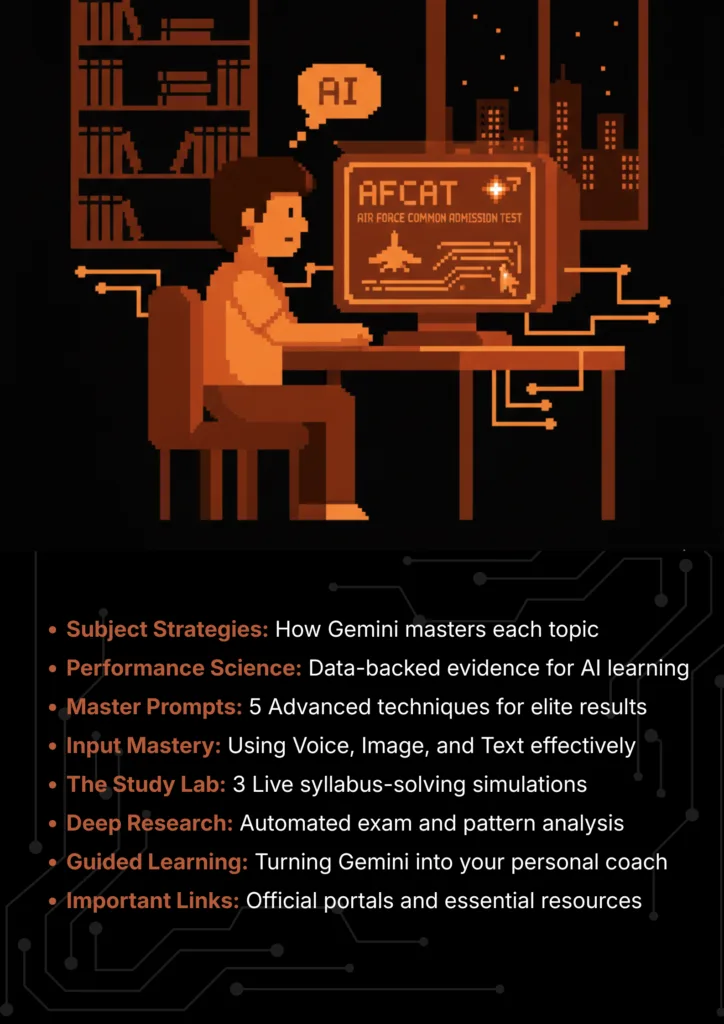
AFCAT is your direct entry point into becoming a commissioned officer in the Indian Air Force, opening the door to the Flying, Technical, and Ground Duty branches that shape the rest of your career. To succeed, you need to clear a tightly timed written exam covering Numerical Ability, English Language, Reasoning, and General Awareness, and then carry that same sharpness into the AFSB interview. Balancing five different subjects, keeping up with fast-moving current affairs, and building the speed to solve problems under real time pressure can feel overwhelming without a structured plan — but the fact that you're here, actively looking for a smarter way to prepare, already says something about how seriously you're taking this. With the right strategy, cracking AFCAT is absolutely within reach.
That strategy starts with a study partner available at 2am the night before a mock test: Artificial Intelligence. Used the right way — not just asked for answers, but asked to teach — AI can turn a two-minute calculation into a twenty-second shortcut, quiz you like a live instructor until a concept actually sticks, and keep your General Awareness prep grounded in what's genuinely current instead of outdated notes. Every technique on this page works on any AI chatbot you already have access to — ChatGPT, Gemini, Claude, or Perplexity. The point was never which tool you use. It's how you ask.
Everything on this page in 30 seconds, before you dive in.
Free guides, AI news, and prompts — straight to your inbox
New exam guides as we drop them, the AI tools and updates actually worth knowing about, and tips & tricks you can use the same day. No spam, no fluff — including Hindi and Bengali as they launch.
Explore Every Topic
Tap any card to see the full breakdown.
How AI Helps With Every AFCAT Subject
- Numerical: AI breaks a formula down step by step, then shows the shortcut version, turning a 2-minute problem into a 20-second one.
- English: AI teaches grammar the way you'd pick it up in conversation, and builds vocabulary around military and defense terms.
- Reasoning: AI turns a confusing visual puzzle into a plain checklist, so you're following a process instead of guessing.
- Awareness & Current Affairs: AI links facts to short stories so they stick, and filters daily news down to what could actually appear in the exam.
1. Numerical Ability Step-by-Step Logic
- Solve it two ways: give AI a problem and ask for both the textbook method and the shortcut — seeing why the shortcut works, not just what it is, is what makes it stick under exam pressure.
- Drill on demand: once you've learned a shortcut, ask AI to generate 10 more problems of the same type at rising difficulty, so you practice it until it's automatic.
- Guided practice: tell AI to give hints instead of answers, so you're the one doing the solving — see the Guided Learning card for the exact prompt.
- Diagnose your mistakes: after a mock test, paste your wrong answers and ask AI to find exactly which step your calculation broke down at, not just what the correct answer was.
- Snap a photo instead of retyping: most AI chatbots can read an image — photograph a problem straight from your textbook or a past paper and let AI solve it from the picture, no retyping the numbers by hand.
2. English Language Language Instinct
- Context that sticks: ask AI to explain a grammar rule using a military-themed example sentence, so it's tied to language you'll actually see in the exam.
- Learn to scan, not just answer: paste a reading comprehension passage and ask AI to show you which line and which keyword gave away the answer — this teaches you to scan faster yourself, not just get one right answer.
- Active vocabulary drilling: have AI quiz you on synonyms and antonyms one at a time, revealing the answer only after you guess.
- Grammar feedback with the rule attached: paste your own practice answers and ask AI to correct mistakes and name the specific rule behind each one.
- Practice out loud, not just on-screen: use voice mode to speak your answers or talk through a passage — hearing yourself catches awkward phrasing and pronunciation issues that typing never reveals.
3. Reasoning Aptitude Pattern Master
- Describe, don't just solve: put a visual or spatial pattern into words and ask AI to explain the underlying rule governing it, which transfers to other questions of the same type.
- Build a reusable checklist: ask AI to break a multi-step logic puzzle into a numbered decision checklist you can apply to similar questions on exam day.
- Guided pattern-spotting: use AI in question-only mode — it asks you leading questions instead of solving it, building your own pattern recognition instead of just showing you one worked example.
- Trap-spotting drills: ask AI to generate a puzzle with a common wrong-answer trap built in, then explain exactly why that trap is tempting — so you learn to spot it live.
4. General Awareness Strategic Recall
- Facts as stories, not dates: ask AI to link a historical or defense fact to a short cause-and-effect story instead of a bare date — stories survive exam pressure better than isolated facts.
- Build a memory web: give AI one topic and ask it to map 3–4 related facts you're likely to be tested on together, so recalling one pulls up the rest.
- Flashcard-style quizzing: have AI test you on static GK one fact at a time, only moving on once you've gotten it right twice.
- Understand the "why": ask AI to explain why an event happened when it did — so you can reason your way to the answer even if you've forgotten the specific date.
5. Current Affairs Real-Time Briefing
- Compress, don't consume: ask AI to turn a week's worth of defense and military news into 5 exam-relevant bullet points instead of reading full articles.
- Turn summaries into practice questions: ask AI to convert its own current-affairs summary into likely MCQ-style questions, so you're practicing recall, not just recognition.
- Flag what's gone stale: feed AI last month's notes and ask it to identify anything that likely needs a "last 12 months" refresh — pairs directly with the Knowledge Grounding technique.
- Connect news to static GK: ask AI to link a current event (a new aircraft induction) to a related static fact (that aircraft's history), so both stick together in memory.
You'll stay updated effortlessly, making you confident for both the written exam and the interview stage.
The Research Behind AI-Assisted Prep
- Kestin et al., Harvard (Scientific Reports, 2025): AI-tutored students learned the same material in 49 minutes that took 60 minutes in an active-learning classroom, and reported feeling more engaged.
- Wang et al., Stanford (2025): in a trial with 900+ tutors and 1,800+ students from underserved communities, AI-assisted tutors got students to master 4 percentage points more math topics — up to 9 points for students with less-experienced tutors.
- Eedi.com & DeepMind RCT (2025): 165 UK students working with a closely supervised AI tutor solved brand-new problem types successfully 66% of the time, edging out human-only tutoring.
- Bastani et al., Wharton/Penn (PNAS, 2025): unrestricted AI access boosted practice scores 48%, but dropped unassisted exam scores 17% — real evidence that structure, not just access, is what makes AI study help actually work.
- Gerlich, Societies (2025): a study of 666 people found heavier AI tool use was linked to measurably lower critical thinking scores — the more you let AI think for you, the less practice your own critical thinking gets.
- Shen & Tamkin, Anthropic (2026): in a randomized trial, developers who used AI to learn an unfamiliar skill scored 17% lower — nearly two letter grades — on a follow-up test than those who learned it unaided, with full delegation producing the biggest drop.
- Sánchez-Vera, Education Sciences (2025): in a study built specifically around exam preparation, students rated an AI study tool 95.7% effective for building understanding and 91.4% effective for resolving doubts on their own.
Kestin et al., Harvard — Scientific Reports (2025) AI Tutoring vs. In-Class Active Learning
- A randomized trial found AI-tutored students learned more, in less time, than students in an active-learning classroom taught by an experienced instructor.
- Average learning cycles of about 49 minutes versus 60 minutes for the classroom group.
- The AI-tutored group also reported higher engagement and motivation.
The takeaway: one-on-one AI tutoring can outperform even a well-run active classroom, largely because it adapts pace and questions to one specific student instead of a whole room. For AFCAT, that means using AI to quiz you directly on Reasoning and Military Aptitude, rather than just reading through notes.
Wang et al., Stanford — EdWorkingPaper (2025) Human Tutors + AI Assistance
- The first randomized controlled trial of a human-AI tutoring system in live sessions: over 900 tutors and 1,800 K-12 students from underserved communities.
- Students working with AI-assisted tutors were 4 percentage points more likely to master a topic overall — rising to 9 percentage points for students paired with less-experienced tutors.
- The AI assistance cost roughly $20 per tutor per year to run.
The takeaway: AI assistance closes the gap between an experienced guide and a less experienced one — it doesn't just help the already-strong get stronger. If you're self-studying without an expert around, this is direct evidence that AI can partly substitute for that missing expertise, provided it's used the structured way this page teaches.
Eedi.com & DeepMind RCT (2025) Supervised AI Tutoring in UK Classrooms
- 165 UK secondary students (ages 13–15) were randomly tutored by either a human, a closely human-supervised AI, or given static pre-written hints.
- Students tutored by the supervised AI solved new, previously unseen problem types successfully 66.2% of the time, versus 60.7% for human-only tutoring.
- Human tutors approved the AI's draft responses with little or no editing over 76% of the time — meaning the AI's suggestions were reliable, not just fast.
The takeaway: this study specifically measured transfer — solving problems the student hadn't seen before, not just repeating what they'd memorized. That's exactly what AFCAT Reasoning and Numerical Ability actually test, which is why this page leans on techniques like Chain-of-Thought rather than rote answer-keys.
Bastani et al., Wharton/Penn — PNAS (2025) The Honest Caution
- In a field trial with ~1,000 Turkish high schoolers, unrestricted GPT-4 access during practice boosted assisted performance by 48% — but the same students then scored 17% worse on an unassisted exam than a control group that never had AI access at all.
- Crucially, a second AI variant — one built with guardrails that forced step-by-step hints instead of direct answers — avoided this drop entirely, while still boosting practice performance by 127%.
- The difference wasn't whether students used AI. It was whether the AI was structured to make them think, or structured to let them skip thinking.
The takeaway: this is the single most important finding on this card, and most sites won't show it to you because it complicates the "AI makes you smarter" pitch. Unstructured AI use can genuinely hurt your unaided performance — exactly the scenario on exam day, when you won't have AI in the room. This is the actual reason this page teaches specific prompting techniques instead of just telling you to "go chat with an AI": the technique is what determines whether you end up like the harmed group or the helped group.
Gerlich, Societies (2025) The Cognitive Offloading Warning
- A mixed-methods study of 666 participants across age groups and education levels, combining surveys, a standard critical-thinking assessment, and interviews.
- Found a significant negative correlation between how often someone used AI tools and their critical thinking scores.
- The link was explained by "cognitive offloading" — the more people let AI do the thinking, the less practice their own critical thinking got, and the weaker it measurably became.
- Younger, heavier AI users showed both the strongest dependence on the tools and the lowest critical thinking scores.
The takeaway: the study's own author is upfront that this shows a correlation, not proof of direct cause and effect. But it lines up with everything else on this card — AI use itself isn't the risk, how you use it is. If AI is doing your thinking for you instead of guiding you to think it through yourself, this is what that habit measurably costs over time.
Shen & Tamkin, "How AI Impacts Skill Formation" (2026) Anthropic's Own Honest Finding
- A randomized controlled trial with 52 developers learning an unfamiliar Python library, either with AI assistance or completely unaided.
- The AI-assisted group scored 17% lower — nearly two full letter grades — on a follow-up comprehension quiz testing the exact concepts they'd just used.
- The AI group finished only marginally faster, a difference too small to be statistically meaningful — meaning they gained essentially no time, and lost real understanding.
- Participants who fully delegated the task to AI, without engaging with what it produced, showed the largest skill deficits of anyone in the study.
The takeaway: this is Anthropic's own research team studying exactly the kind of risk their own product can create, and being straightforward about it. It's the clearest evidence yet for the principle this whole page is built around — use AI to guide you through a problem so you learn it, not to hand you a finished answer so you don't have to.
Sánchez-Vera, Education Sciences (2025) Built Specifically Around Exam Prep
- Unlike the studies above (general tutoring/classroom settings), this one specifically tracked students using an AI chatbot to prepare for final exams over one month — 42 students, 704 interactions.
- Students rated the AI 95.7% effective at aiding concept understanding and 91.4% effective at resolving specific doubts on their own, without waiting for a teacher.
The takeaway: this is the closest match to how you'll actually use this guide — not a classroom tool, but a self-directed exam-prep partner you consult on your own schedule. That's exactly the AFCAT self-study reality: no instructor on call at 11pm the night before a mock test, but AI is.
Six Industry-Standard Prompting Techniques
- PTCF: tell the AI who to act as, what to explain, what source to stick to, and what format to answer in.
- Chain-of-Thought: have it solve a problem one verified step at a time, so an early mistake doesn't wreck the final answer.
- Knowledge Grounding: tell it to only use official sources from the last 12 months, so defense and current affairs answers stay accurate.
- Constraint-Based Prompting: set hard rules like a word limit and "no filler," and get short, sharp revision notes instead of a wall of text.
- Iterative Refinement: have it explain a concept, then check whether you understood before moving on, like a real back-and-forth with a tutor.
- Blueprint Strategy: give it the exact table or layout you want, and it fills that in with your information.
1. The PTCF Framework Role-Based Strategy
What PTCF Actually Means: Persona, Task, Context, Format — four things you spell out in one prompt instead of asking a vague question. Persona tells the AI WHO to act as (an IAF Wing Commander, not a generic assistant). Task tells it WHAT to explain. Context tells it what source, difficulty level, or situation to stick to. Format tells it HOW to structure the answer back to you.
Where it helps most: General Awareness and Military Aptitude, where a generic AI answer tends to drift into information that's too broad or not exam-relevant. PTCF forces it to answer like someone who actually knows Air Force specifics, pitched at your level, in a format you can revise from directly.
Persona: Act as an [Expert Role: e.g., IAF Wing Commander, Defense Analyst]. Task: Explain [Your Topic: e.g., BVR Missile Capabilities, History of the IAF]. Context: Apply this specific background: [Source Context: e.g., Use only the official AFCAT 1/2026 Notification] [Difficulty Context: e.g., Explain for an AFCAT Aspirant] [Environment Context: e.g., Assume a high-pressure SSB Interview scenario] Format: Provide the answer as a [Structure: e.g., Technical Briefing, 5-Point High-Yield List].
Great for: Getting answers that are 100% aligned with the Air Force perspective. Topics: Military Awareness, Aviation Physics, Defense Strategy.
2. Chain-of-Thought Logic-Verify Strategy
What Chain-of-Thought Actually Means: instead of letting the AI jump straight to a final answer, you make it show its work — list what's given, state the rule it's applying, then calculate one verified step at a time, checking each line before moving to the next.
Where it helps most: Numerical Ability and Reasoning, AFCAT's most calculation- and logic-heavy sections. A wrong Step 1 — like misreading which train is faster — silently wrecks every step that follows it. Chain-of-Thought is what catches that error before you copy down a confidently wrong final answer.
Solve this [Subject: e.g., Numerical Ability, Reasoning] problem using Chain-of-Thought. Step 1: List all given [Variables/Data Points] and units from the question. Step 2: State the core [Formula/Logical Rule] and verify its relevance. Step 3: Show the calculation step-by-step, verifying the logic of each line before moving to the next. Question: [Insert your math or reasoning question here]
Great for: Solving tricky math or reasoning sets where one small error leads to a wrong answer. Topics: Time and Distance, Probability, Venn Diagrams, Number Series.
3. Knowledge Grounding Time-Stamp Strategy
What Grounding Actually Means: you name the exact sources the AI is allowed to use — specific websites like pib.gov.in — and set a time window, like "only the last 12 months," instead of letting it pull from anywhere on the internet.
Where it helps most: General Awareness and Current Affairs, where defense news changes monthly. An ungrounded AI might confidently hand you last year's Air Chief Marshal or an outdated aircraft induction list — grounding is what keeps its naturally broad knowledge pointed only at what's current and actually testable.
Research the [Topic: e.g., Recent IAF Joint Military Exercises, New Appointments]. Constraint: Only use info from official portals: [Domain 1: e.g., pib.gov.in] and [Domain 2: e.g., afcat.cdac.in]. Recency Rule: Prioritize data published in the last 12 months. Output: Provide the official summary and the direct link to the source.
Great for: Fact-checking current affairs, new aircraft inductions, or official exam notifications. Topics: Defense Current Affairs, New IAF Equipment, Exam Dates and Eligibility.
4. Constraint-Based Prompting The Anti-Fluff Method
What Constraint-Based Prompting Actually Means: you give the AI hard rules — a strict word limit, a required tone, a list of banned filler phrases — instead of letting it write however it defaults to. AI's natural style tends to be wordy and hedgy ("It's important to note that..."), which is the opposite of revision-ready.
Where it helps most: Static GK and General Science, where you need dozens of crisp, memorizable facts rather than essays. This constraint is what turns a rambling paragraph into a flashcard you can actually drill.
Explain [Concept: e.g., Operation Meghdoot, Bernoulli's Principle]. Constraint 1: Use only [Specific Source: e.g., Standard Defense Handbook] terminology. Constraint 2: Keep the response under [Limit: e.g., 60 words]. Constraint 3 (Negative): Do not use AI-filler phrases like "Sure, here is your answer." Format: Use simple bullet points.
Great for: Concise revision notes, static GK flashcards, and high-yield definition lists. Topics: Military Operations, General Science, Static GK, Awards and Honors.
5. Iterative Refinement Tutor Mode Strategy
What Iterative Refinement Actually Means: instead of a one-shot explanation, you turn it into a back-and-forth — the AI explains something, then stops and checks whether you actually understood before moving on, rather than dumping everything at once.
Where it helps most: technical General Awareness topics (how jet propulsion works) and multi-part Reasoning puzzles, where genuinely understanding the concept matters more than memorizing one worked example. A check-for-understanding question forces you to prove you can apply the idea, not just recognize it.
Explain [Topic: e.g., Principles of Jet Propulsion, Radar Systems]. Instruction: Provide a high-level technical summary first. Feedback Loop: Ask me if I want it simpler for basics or more technical for the exam. Active Recall: Once I am satisfied, provide one 'Check-for-Understanding' question based on your explanation.
Great for: Mastering abstract or complex concepts that require a dialogue to fully grasp. Topics: Aircraft Engines, Aerodynamics, Indian Geography, Complex Reasoning.
6. The Blueprint Strategy IndiaShouldKnow Method
What the Blueprint Strategy Actually Means: instead of asking the AI to write about something and hoping it lands on a useful format, you hand it the exact structure first — "a 4-column table with these headers" — and only then give it the raw information to fill in.
Where it helps most: sprawling General Awareness topics like aircraft comparisons or defense operation timelines, where the difference between a messy paragraph you have to reorganize yourself and a ready-to-scan comparison table is exactly this technique.
Make a [Desired Output: e.g., Missile Comparison Table, SSB Interview Roadmap]. Layout Blueprint: [Structure: e.g., 4-column table, Numbered list]. Style: [Vibe: e.g., Military Briefing, Minimalist]. Strict Rule: Adhere to the structure provided; no conversational filler. Use this information: [PASTE_DATA_OR_TEXT_HERE]
Great for: Organizing messy current affairs data into clean, professional comparison charts. Topics: Aircraft Comparisons, War Memorial Lists, Strategic Roadmaps.
Deep Research With AI
- Deep research means using AI to connect your General Awareness prep to real, current military updates — new aircraft inductions, joint exercises, defense deals — not just static, memorized facts.
- Ground the AI in your official AFCAT syllabus PDF and sources like PIB and the IAF website first, so its research stays inside what's actually testable instead of pulling from random defense blogs.
- Two ready-made research prompts: one produces a summary plus practice MCQs on a topic, the other builds a full comparison table (like Fighters vs. Transport aircraft) directly from raw information you provide.
What Is Deep Research?
Deep research for AFCAT involves using an AI chatbot to link your General Awareness topics with real-time military updates and logical reasoning patterns. It turns the AI into a research partner that helps you understand the "Why" behind defense current affairs and spatial reasoning, moving beyond simple rote learning to the strategic mindset required for the Indian Air Force.
- Military GK Integration: Finds the latest induction data and operational history for aircraft and weapon systems.
- Reasoning Pattern Analysis: Breaks down spatial and verbal reasoning patterns unique to the AFCAT format.
- Current Affairs Synthesis: Summarizes joint military exercises, defense deals, and strategic alliances.
- Targeted Vocabulary Building: Builds an exam-focused word bank instead of a random list.
Grounding & Context
What it is: "Grounding" means tethering the AI to official IAF sources so it doesn't give you unverified or outdated information that could confuse your preparation.
Why it matters: Defense data is sensitive and constantly changing. Grounding ensures you are studying from the IAF Career Portal and Press Information Bureau (PIB) guidelines.
How you do it: Download the latest official AFCAT notification or syllabus PDF from CDAC → upload it to your AI tool → "Filter all your future research through the specific sections and difficulty levels found in this official AFCAT syllabus."
Two Deep-Research Prompt Methods
Structured Prompt Style — "System, Task, Range": Use this structured method to ensure the AI acts like an Air Force entry specialist rather than a general information chatbot.
"Act as an AFCAT exam expert. Your task is to research the latest major joint military exercises involving the Indian Air Force in the last 12 months. Write a 200-word summary and create three multiple-choice questions based on this research. Use only official government and verified defense news sources."
The IndiaShouldKnow Technique — "Reverse Engineering": Describe the exact strategic depth and format you need before the AI processes the raw defense data.
"I want to create a high-density comparison table for [IAF Aircraft Categories, e.g., Fighters vs Transport]. Format: A 4-column table (Aircraft Name, Origin, Role, Unique Feature). Tone: Professional, military, and precise. Intent: To master aircraft identification for General Awareness MCQs. Constraints: No fluff. Every point must be under 15 words. Use the official IAF website context I provided. Once generated, I will ask you to create a logic-based reasoning question for this table."
Pro Tips for Deep Research
- The "Logic Loop": After an answer, ask: "What is the most common mistake candidates make when identifying these spatial patterns?" to identify exam traps.
- Verify Defense Stats: Always cross-check with a live web search to verify the latest names of Commanders-in-Chief or current defense budget percentages — an AI's training data can be out of date.
- Visual to Text: Describe a rotation or pattern to the AI and ask it to explain the "unseen" mathematical rule governing the movement.
- Chain of Reasoning: For Numerical Ability shortcuts, ask the AI to explain the derivation step-by-step so you can apply it mentally under pressure.
Guided Learning With AI
- Guided learning turns AI into an instructor that quizzes you instead of just answering your questions — it withholds the answer, gives a hint, and only moves on once you've worked through the logic yourself.
- This matters most for Reasoning and Numerical Ability, where AFCAT tests whether you can solve NEW problems under time pressure — repeated guided practice builds that speed in a way reading solved examples never does.
- Three specific ways to run it — Scaffolding, Socratic, and a full mock-quiz mode — each ending in a performance report showing exactly what to drill next.
What Is Guided Learning With AI?
For AFCAT aspirants, guided learning with AI is like having a specialized Air Force instructor available 24/7 to help you crack the logic behind Verbal and Numerical ability. Instead of just memorizing formulas or vocabulary lists, you use an AI chatbot to simulate a testing environment where it identifies gaps in your reasoning and explains aptitude patterns in ways that match your learning style.
- Master Logical Reasoning: Breaks down complex patterns and spatial ability puzzles step by step.
- Improve Verbal Speed: Identifies why your interpretation of a passage was off and helps you find clues faster.
- Numerical Accuracy: Coaches shortcuts for Profit & Loss or Time & Work within the exam's strict time limits.
How To Do It, In Short
1. Define the Role: Tell the AI it is an expert AFCAT Instructor and Aptitude Coach.
2. Set the Boundary: Tell it NOT to give you answers immediately — insist on logic-based hints first.
3. Interactive Dialogue: Ask it to explain a reasoning pattern or quiz you one question at a time.
4. Feedback Loop: Provide your steps for a problem, and let the AI correct your reasoning process.
Three Ways to Prompt Your AI Tutor
Conversational Scaffolding: Start with basic rules and let the AI guide you toward full reasoning puzzles through back-and-forth chat.
"I am studying for the AFCAT exam, specifically focusing on [Subject/Chapter]. I want you to act as a supportive instructor. Start by asking me what I already know about [Specific Topic], and then help me build my understanding by asking follow-up questions that connect basic rules to complex reasoning puzzles. Don't give me all the information at once; let's take it step-by-step."
The Socratic Method: The AI asks disciplined questions instead of explaining — forcing you to find the logic yourself, critical for unseen problems on exam day.
"I want to learn the logic behind [Topic]. Act as a Socratic tutor for AFCAT prep. Do not give me the explanation. Instead, ask me a leading question that helps me realize the core reasoning pattern behind this. Once I answer, ask another question to push my thinking into faster shortcuts until I have fully grasped the concept."
The IndiaShouldKnow Method — "Reverse Engineering": Define the exact "shape" of the session — AFCAT-style questions, one at a time, with a performance report — before handing over your raw study material.
"Intent: Act as an expert IAF Instructor specializing in [Subject]. Context: I am preparing for the AFCAT exam and need to master [Chapter/Topic]. Format Constraints: * Conduct a 'Numerical Ability & Reasoning' quiz session. * Ask exactly one question at a time. * Wait for my response before moving to the next. * If I am wrong, provide a logic-based hint first. * Use a professional and encouraging tone. * After 5 questions, provide a 'Performance Report' in a table format (Column 1: Aptitude Concept, Column 2: Mastery Level 1-10, Column 3: Time-Saving Area). Raw Data: [Paste your notes, mock test questions, or syllabus here] Instruction: Once you understand these constraints and the data provided, acknowledge this by asking the first question."
Tips for Guided Learning
- Be Honest with the AI: If you don't understand a hint, say "I don't see the pattern, explain it using a different example."
- Use Voice Mode for Verbal Ability: Talking through reading comprehension or synonyms out loud builds the mental speed needed for English.
- Feed it Mock Test Logic: Paste tricky questions from past AFCAT papers so the AI calibrates to the exact difficulty level of the real exam.
- Review the Performance Report: Ask the AI to build a 5-minute drills plan just for your weakest areas.
- Refine, Don't Restart: Once the AI gives you a good result, build on it instead of starting over — try "That was great, but make the questions more focused on [specific sub-topic] and more time-bound."
The Study Lab
See all three prompting strategies applied to one real AFCAT question. Switch subjects, switch strategies, then hit "Enter Prompt" to see the AI's simulated answer.
Bookmark These
FAQs About Using AI to Study
Six honest questions worth answering before you build AI into your prep routine.
No — treat an AI like a very well-read assistant, not an oracle. It can misunderstand your question, work from outdated information, or "hallucinate": confidently state something false as if it were fact.
Especially watch for: defense-specific details like current appointments, aircraft specifications, or recent inductions — these change often, and an AI's training data can lag behind the real, current answer.
Rule of thumb: use AI answers as a strong starting point, never as the final, unverified truth for anything you're about to write down as an exam answer.
- Check it against the official syllabus: the AFCAT notification from CDAC and the IAF's own portal are always your most reliable comparison points.
- Use official sources specifically: for current affairs and defense facts, cross-check against the Press Information Bureau (pib.gov.in) rather than a random coaching blog — this is exactly what the Knowledge Grounding technique on this page is built to enforce.
- Cross-reference: ask a second AI tool the same question, or run it through a normal search engine — agreement across sources is a good sign.
- Trust your instincts: if an answer feels too neat, too strange, or too convenient, dig further before relying on it.
It comes down to who's doing the thinking.
Preparation (fine): practicing mock interview questions with AI, getting feedback on how you structured an answer, or rehearsing group discussion topics out loud. You walk into the AFSB having actually built the skill yourself.
The real risk (not fine): memorizing an AI-written answer word-for-word and reciting it. The AFSB is designed to test how you think under pressure across multiple days — a memorized script falls apart the moment a follow-up question doesn't match what you rehearsed, and interviewers are specifically trained to notice this.
- No, it isn't: AFCAT is a proctored computer-based test with zero AI access during the exam itself — using AI to prepare beforehand is no different from using a textbook, a coaching class, or a tutor.
- The real risk isn't a rule violation, it's over-reliance: if you let AI do the solving for you during prep instead of practicing the method yourself, you'll be unable to perform unaided on exam day, when it actually counts.
- Do the heavy lifting yourself: use AI to understand a topic or check your logic, then close the chat and solve a similar problem completely on your own to confirm you actually learned it.
Yes — AI learns from text written by people, and it can absorb and repeat human biases in the process. Watch for:
- An opinion presented with the confidence of a fact.
- Only one side shown on a topic with real, multiple viewpoints — including sensitive defense or geopolitical topics that may come up in your interview.
- Generalizations about groups of people based on background, gender, or nationality.
The safest habit: pull information from multiple, varied sources rather than trusting a single AI response on anything contested — especially before an SSB interview, where a one-sided view can look like a lack of balanced judgment.
Be careful — most public AI conversations aren't private. Many AI companies use conversations to improve their systems, and data breaches are always a possibility.
Simple safety rule: don't upload or paste anything you wouldn't want a stranger to see — personal identification details, your admit card, or any financial information.
One more AFCAT-specific note: avoid uploading paid coaching material or mock test PDFs you didn't create yourself — beyond the privacy concern, it's often a copyright violation of the coaching provider's content.
Don't lose this — join for more like it
Exam guides, AI news worth your time, tips & tricks, and more — one email, free, whenever something's worth sending. Unsubscribe anytime.